

afwrussia
Facebook
Tumblr-square
Twitter
Instagram
aurora fashion week
Stylish look of 21 century
What Should You Know Abot Us
We review all the fashion trends of today, style, hits of the season, collaborations of all leading fashion brands of clothing, as well as the lives of models, everyday life, fashion bloggers, beauty bloggers, beautiful life and everything related to money.

Mail: contact@afwrussia.com
Moday-Friday 24/7
Tel: 466 – 0706 – 4554 – 2323
Office #1: Riverton Wyoming 82501, USA
Office #2: 316-324 N Main St, White River, SD 57579, USA
Why will you love our blog?
The best sets for autumn-winter
The best autumn-winter sets from the most famous brands aurora fashion week
Reviews of fashion shows and performances
Fashion shows, models, you will feel like one of the jury members
Predict winners and get prizes
Predict winners and become a winner yourself. For details, please contact our mail

Our top this season
The past fashion season dictated new rules – everything that was in the past decade will remain in the past decade. Hoodies and ugly boots are being replaced by architectural cuts, sparkling dresses, and latex suits. The Matrix aesthetics are back. The big trend of the past Fashion Weeks is leather goods in all possible forms: coats, raincoats, jackets, trousers, skirts, shoes, and accessories.
A stylistic technique that has not left the world catwalks for several seasons. You can combine anything – for example, leather clothing in different colors, like Prada, or a wide variety of fabrics, like Gucci.
Fringe, without losing its relevance, continues the triumphant march on the podiums and collects applause. In the new season, it can be found not only on western-style clothes but also in evening dresses and bags.
Modern Trends


Previous
Next


Previous
Next
Facebook
Tumblr-square
Twitter
Instagram
-
Fabric Stretch and Recovery: Why Returning to Shape Needs Its Own Measurement
A fabric can stretch comfortably during movement and still look loose after it is released. That is why stretch and recovery belong in separate descriptions. Stretch concerns how far a material extends under stated conditions. Recovery concerns what happens when the force is removed, including how much extension remains after a defined interval.
For clothing, the distinction helps explain why two garments with similar give can behave differently at the knees, elbows or waistband. A fabric label and a quick tug offer useful impressions, but neither replaces a comparison with clear dimensions, conditions and timing.
Define the length before using a percentage
Percentage extension needs an original reference length. If a marked section begins at 100 millimetres and extends to 130 millimetres under a stated load, the added length is 30 millimetres. Dividing that change by the original 100 millimetres gives 30 per cent extension.
The number describes the particular conditions used. It should not be treated as a permanent property independent of force, direction, time or previous handling. A knitted fabric pulled across its width may behave differently from the same fabric pulled along its length.
When reading a specification, check what “stretch” means in that document. Does it name a test method, a direction and a defined loading condition? A percentage with no measurement description may be useful marketing shorthand, but it is not a complete technical comparison.
Use the correct method for the fabric type
Test methods have scopes. The official ASTM D2594/D2594M description concerns stretch properties of knitted fabrics with low power. The ASTM D3107 description concerns woven fabrics made from stretch yarns. Their existence illustrates why the fabric construction belongs in the test description.
The worked examples here are simple arithmetic exercises, not certified implementations of either standard. A formal result requires the appropriate complete method and equipment. Do not label a hand measurement “ASTM tested” merely because the same words appear in a spreadsheet.
For a buying or design discussion, ask whether the compared fabrics were evaluated with compatible methods. Results obtained under different forces or recovery intervals may not support a direct ranking, even when both are printed as percentages.
Compare equal stretch with different recovery
Consider two fictional specimens. Both start at 100 millimetres and reach 130 millimetres under the same imagined loading condition. After an equally defined rest interval, specimen A measures 103 millimetres and specimen B measures 110 millimetres. Both initially extended by 30 per cent, but they did not return equally close to their starting lengths.
Constructed dimensions, not laboratory test results Measurement Specimen A Specimen B Original length 100 mm 100 mm Loaded length 130 mm 130 mm Length after stated rest 103 mm 110 mm Residual growth relative to original 3% 10% Using an illustrative recovery calculation, A recovered 27 of the added 30 millimetres, or 90 per cent of its extension. B recovered 20 of the added 30 millimetres, or approximately 66.7 per cent. These recovery percentages use the added extension as the denominator, while residual growth uses the original length.
That difference in denominators is easy to overlook. Three per cent residual growth does not mean 97 per cent recovery under this calculation. Always state the formula rather than assuming two percentages must sum to 100.
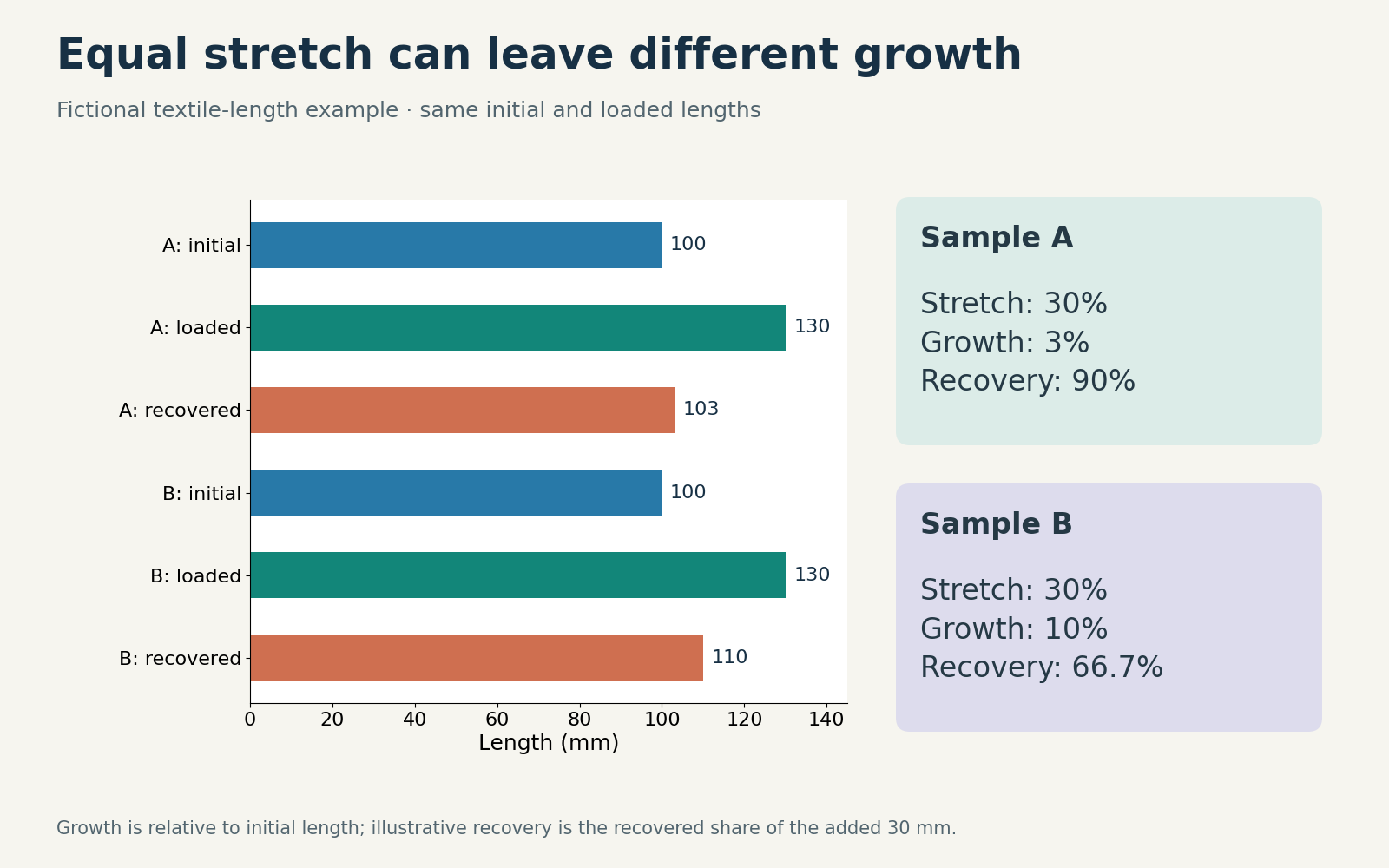
Both samples stretch by 30%. Residual growth is 3% versus 10%; the illustrated recovered share of the added extension is 90% versus 66.7%. These are teaching values, not test results. Image credits. Time belongs in a recovery claim
“After release” is incomplete if the material continues changing during the observation interval. A measurement taken immediately and one taken later can differ. Specify the rest period when recording a result, and compare specimens at the same stated time.
A useful worksheet has separate fields for loaded duration and recovery duration. It also records whether the specimen had been stretched previously. Repeated handling may make a casual showroom comparison difficult to interpret because one sample has experienced a different history from another.
If you photograph the specimen, include a scale and keep the camera position consistent. Perspective can make two equal lengths appear different. The photograph should support the measurement record, not become an excuse to estimate millimetres from an uncalibrated image.
Use the same marked section for all three lengths in the arithmetic exercise. Measuring the full specimen initially and a shorter marked section afterward would change the reference without announcing it. Record the values before rounding, and retain the measurement resolution. If a ruler can only support a whole-millimetre reading, a spreadsheet displaying four decimal places should not be mistaken for four decimal places of measurement accuracy. The calculated percentage can be rounded to a level consistent with the observations.
A garment adds seams, fit and construction
A fabric result concerns the tested specimen. A finished garment adds seams, shaping, panels and the way forces are distributed during wear. A well-performing fabric can be used in a design that restricts movement, while a garment can feel forgiving because of its cut rather than a large measured stretch percentage.
Keep fabric and garment observations in separate columns. “The material returned close to its original marked length” and “the jacket allowed comfortable reaching” are both useful statements, but they describe different tests. One should not be presented as a substitute for the other.
For a practical comparison, choose the question first. Are you investigating bagging after repeated bending, comfort during movement or recovery after a single extension? The most informative observation depends on that question, so collecting one convenient number may leave the real issue unanswered.
Read stretch language with a measurement checklist
When a product description claims excellent recovery, look for the reference length, direction, loading conditions, rest interval and calculation. If some details are unavailable, record that limitation without inventing them. You can still describe the garment’s feel while keeping that observation separate from a formal performance claim.
The language also prepares a useful bridge into biology. Clothing fibres and biological elastic tissues can both be discussed using extension and recovery, but they are made from different materials and tested in different settings. The shared word “elastic” is a starting point for comparison, not proof of shared chemistry.
Understanding the measurement first makes the next distinction easier: elastane in a clothing label is not elastin in a tissue. Similar names can describe different substances, and a clear material identity matters as much as a clear percentage.
-
Your Guide to Choosing the Best Peptides for Weight Loss

In the ever-evolving landscape of health and fitness, the quest for effective weight loss solutions remains a perennial pursuit for many. Among the plethora of options available, peptides have emerged as a promising avenue for those seeking to shed excess pounds and sculpt their bodies. The best peptides for weight loss are short chains of amino acids that play crucial roles in various physiological functions, including metabolism and fat loss. With a growing interest in peptide-based weight loss therapies, it’s essential to understand how to choose the best peptides tailored to your needs. In this guide, we’ll explore the key factors to consider when selecting peptides for weight loss.
- Consultation with a Healthcare Professional: Before delving into any peptide regimen, it’s imperative to consult with a qualified healthcare professional, preferably one well-versed in peptide therapy. They can assess your medical history, current health status, and weight loss goals to provide personalized recommendations. Peptide therapy isn’t suitable for everyone, and a healthcare provider can offer insights into potential risks, benefits, and suitable peptide options based on your individual needs.
- Research and Understanding: Educate yourself about the different types of peptides commonly used for weight loss and their mechanisms of action. Peptides such as Ghrelin, ozempic weight loss before and after pictures, Ipamorelin, and Melanotan II have gained attention for their potential effects on appetite regulation, metabolism, and fat loss. Understanding how each peptide works can help you make informed decisions and set realistic expectations regarding their efficacy and potential side effects.
- Quality and Purity: When purchasing peptides, prioritize quality and purity. Opt for reputable suppliers known for adhering to stringent quality control standards and conducting third-party testing to ensure the integrity of their products. Pharmaceutical-grade peptides are subject to rigorous manufacturing processes that minimize the risk of contamination and ensure consistency in potency. Avoid purchasing peptides from dubious sources or those lacking transparency in their production practices.
- Mode of Administration: Peptides can be administered through various routes, including subcutaneous injections, oral tablets, or nasal sprays. Consider your preferences, comfort level with self-administration, and lifestyle factors when choosing the mode of administration. Subcutaneous injections are commonly preferred for their direct delivery and reliable absorption, whereas oral or nasal formulations may offer convenience but can vary in efficacy and bioavailability.
- Dosage and Frequency: Dosing protocols for peptides can vary depending on the specific compound, individual response, and treatment goals. Start with conservative doses and gradually titrate upwards while monitoring for any adverse effects. It’s crucial to follow recommended dosage guidelines provided by your healthcare provider or the peptide manufacturer to optimize safety and efficacy. Avoid exceeding recommended doses, as this can increase the risk of side effects without necessarily enhancing results.
- Monitoring and Adjustments: Regular monitoring of progress and feedback from your healthcare provider is essential to fine-tune your peptide regimen. Keep track of changes in weight, body composition, energy levels, and any adverse reactions experienced during the course of treatment. Based on your response and goals, adjustments to dosage, frequency, or peptide selection may be warranted to optimize outcomes and minimize potential drawbacks.
In conclusion, choosing the best peptides for weight loss requires careful consideration of various factors, including consultation with a healthcare professional, research, quality assurance, administration method, dosage, and monitoring. While peptides can offer promising benefits in aiding weight loss efforts, they are not a panacea and should be integrated into a comprehensive approach that includes regular exercise, a balanced diet, and lifestyle modifications. By approaching peptide therapy judiciously and responsibly, individuals can harness its potential to support their journey towards a healthier, fitter physique.
-
The Shadows of the Olympics: Unveiling the Secretive World of Doping in Elite Sports

Introduction
The Olympic Games have always been regarded as the pinnacle of athletic achievement, showcasing the extraordinary abilities and dedication of athletes from around the globe. However, behind the scenes, there is a darker side that taints the purity of these celebrated competitions. This blog post aims to shed light on a disconcerting reality – the covert use of performance-enhancing drugs by Olympic athletes and the intricate web of secrecy spun by their coaches.
Unmasking the Veil of Doping

Steroid use has long plagued the world of sports, undermining the spirit of fair play and jeopardizing the health of athletes. In the high-stakes realm of the Olympics, where a split-second advantage can determine victory or defeat, the pressure on athletes and their coaches to deliver exceptional results is immense. Consequently, some coaches resort to clandestine methods, including facilitating the use of testosterone for sale, to gain an unfair edge over their competitors. Among the substances frequently used in such schemes is oxandrolone, a well-known anabolic steroid favored for its mild yet effective performance-enhancing properties. Many athletes seeking an advantage have looked for reliable sources to buy Oxandrolone despite the risks associated with its misuse.
The Coaches’ Code of Silence
To preserve their athletes’ competitive edge while avoiding detection, coaches have perfected a web of secrecy surrounding performance enhancement. They collaborate with doping specialists to craft sophisticated masking techniques, ensuring that banned substances remain undetectable. Access to high-quality products is a crucial factor, and many within these circles turn to trusted sources like MisterOlympia store to obtain reliable compounds. Through strategic drug administration cycles, test manipulation tactics, and the exploitation of regulatory loopholes, these covert operations continue to challenge anti-doping authorities.
PHARMA TEST C 250 (USA Domestic) by Pharmacom: A Glimpse into Performance Enhancement
In the secretive world of elite sports, compounds like PHARMA TEST C 250 (USA Domestic) by Pharmacom often surface in discussions about performance enhancement. Known for its ability to boost strength, endurance, and recovery, it has become a notable product in both athletic circles and doping controversies. The controlled release of testosterone provided by PHARMA TEST C 250 can offer competitive advantages when misused, shedding light on the challenges of maintaining fair play in sports. For those seeking to buy pharma test c250, ethical considerations and sourcing from legitimate suppliers are critical to avoid misuse and ensure responsible use.
The Consequences of Complicity
The repercussions of coaches turning a blind eye to steroid use extend beyond the realm of athletics. By fostering a culture of doping, they perpetuate a harmful cycle that undermines the integrity of sports and sets a detrimental example for aspiring athletes. Furthermore, the health risks associated with performance-enhancing drugs can have severe consequences for athletes’ physical well-being, ranging from cardiovascular complications to irreversible damage to vital organs.
The Fight for a Fair Game
While the battle against doping in sports is ongoing, organizations such as the World Anti-Doping Agency (WADA) and the International Olympic Committee (IOC) continue to enhance their efforts to detect and prevent the use of performance-enhancing drugs. Stricter testing protocols, increased penalties, and the implementation of biological passports are just a few of the measures employed to level the playing field and preserve the integrity of the Olympic Games.
Conclusion
The allure of Olympic glory has unfortunately driven some coaches to compromise their ethical boundaries and engage in the covert facilitation of steroid use. By delving into the secretive world of doping, we can better understand the challenges faced by athletes and the responsibility that falls on the shoulders of coaches. It is imperative that we continue to expose and combat the use of performance-enhancing drugs, safeguarding the integrity of sports and ensuring fair competition for the talented athletes who embody the true spirit of the Olympic Games.